Affiliate feed and platform integrations
Scheduled feed imports, matching and valid affiliate links across several networks.
We build price monitoring into catalogue and comparison software: every observed price is recorded, charted and compared against its own history, so a “drop” means the price really fell against what shoppers could pay before, not against a reference price someone typed into a feed.
On the first night of price history on Cumpără cu AI, the import recorded one point for each of more than half a million shop listings. Each nightly import writes only real changes and returns after a gap. Points older than 13 months fold into monthly summaries.
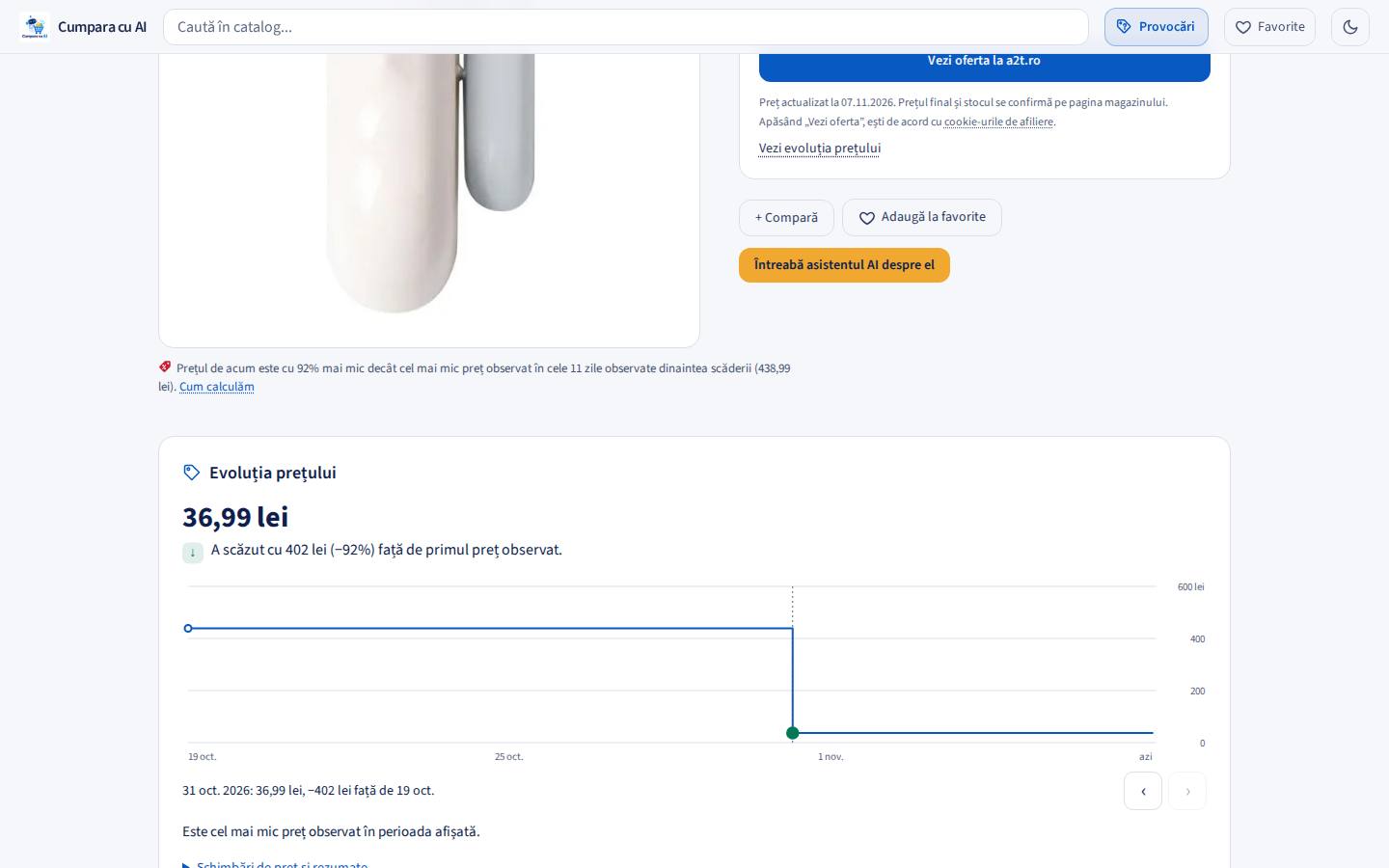
A price drop compares today’s price with the lowest price observed in the 30 days before the fall began, never the highest and never the shop’s “old price”. It needs at least 8 days observed, a complete recent read of that shop, and no other listing already cheaper. Big falls must be seen by two imports. The same rules feed the price drops section, the red tags on cards, email alerts and social posts on Raftul copiilor.
Where prices come from and how a product is identified over time.
What counts as a change, a gap, a drop and a suspicious value.
History that stays fast after years of nightly imports.
Charts and sentences that say what the data shows and nothing more.
Alerts, posts or reports wired to the drop rules.
Because it is a claim, not an observation. Many European consumer rules measure a discount against the lowest price of the previous 30 days. Our rules compare against what was actually observed.
Values outside sane bounds are not recorded, a reading older than the last one is ignored, and very large drops must be confirmed by a second import before they are shown.
Yes: Raftul copiilor’s alerts email a shopper once the observed price reaches the threshold they chose. See transactional email integrations.
Scheduled feed imports, matching and valid affiliate links across several networks.
Alerts and notices triggered by events, with opt-in, queueing, unsubscribe and bounce handling.
Scheduled Facebook and Instagram posts generated from your catalogue, with safety checks.
Search, filters, comparison and product pages that sell, with checkout scoped to your providers.
Tell us what you need in a few sentences. NeedAI Studio answers personally, in English or Romanian.