AI workflow automation
Controlled AI jobs that classify and enrich data, with validation and a hard budget.
We build shopping assistants that turn a visitor’s needs into catalogue searches, useful filters and product comparisons. The assistant reads product facts from your catalogue through application tools, so its answers rest on your real products, prices and shops, with checks that catch answers breaking your rules.
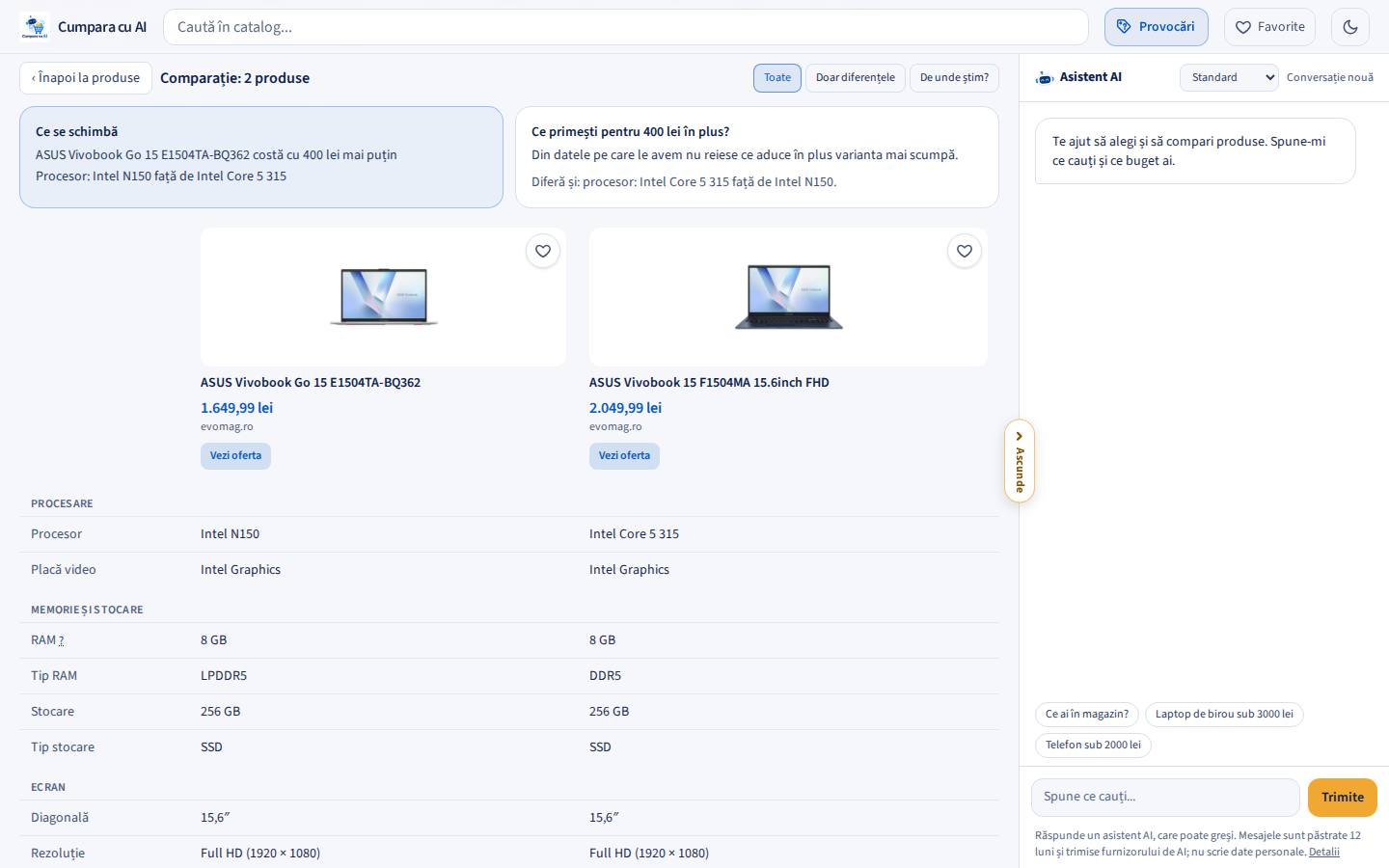
On Cumpără cu AI, a general request such as “a laptop under 3,000 lei” narrows the catalogue and the assistant asks one or two useful questions. A specific request returns a few picks, each with a reason taken from the product data. A measurable requirement like “16 GB RAM” becomes a spec filter, and the assistant says that only products stating the spec are shown.
The design principle is simple: the model does language, the code does facts. Greetings and off-topic questions are answered without a model call. Prices are written by the application, not by the model. On Raftul copiilor, the same engine was adapted to children’s products and checks the age a shop declares instead of assuming it.
You can watch both in the assistant demonstration.
We check which fields exist, how complete they are and what a shopper needs to decide.
Typical questions, the tools that answer them, what the assistant must refuse, and what it says when data is missing.
One catalogue, one language, the agreed actions, on a staging copy of your data.
A written set of scenarios with expected behaviour, run against the pilot, with failures fixed and re-run.
Rate limits, a cost cap, monitoring and a short report after the first weeks of real use.
A subscription chatbot is often enough for delivery, returns and opening-hours questions, or for product search on a standard shop platform it already supports. A custom assistant is worth its starting price when it must work through your own catalogue logic or data sources, follow rules a generic product cannot express, act on your page, or be tested against your own scenarios before each change. The code lives in your repository and the accounts are in your name. If a subscription covers your case, we will tell you. The cost guide explains the trade-off.
It can only name products its tools returned, and prices come from your data. No system that uses a language model is perfect, so we also add checks that rewrite or block answers breaking the rules, and an evaluation set to catch regressions.
The one that fits the task and the budget. Our live assistants run on a low-cost Gemini model with a backup in the configured order; we have also built adapters for Anthropic- and OpenAI-compatible interfaces. The tool layer stays the same when the model changes.
Yes. On our sites the assistant is a column beside the catalogue on large screens and a separate tab on phones, and both views stay in sync.
Controlled AI jobs that classify and enrich data, with validation and a hard budget.
Scheduled feed imports, matching and valid affiliate links across several networks.
Search, filters, comparison and product pages that sell, with checkout scoped to your providers.
Web applications and internal tools, from discovery to a maintained first release.
Tell us what you need in a few sentences. NeedAI Studio answers personally, in English or Romanian.